21/10/2026 09:36
Inside Width or Outside Width? Telegram Quoted Replies for Cambodian Crate Shops

A customer sees a reusable produce crate in your Telegram promotion and asks about its width, stacking arrangement and delivery. Your employee replies, “Yes, that size is available.” Which question did they answer? For a Cambodian shop supplying market vendors, cafés or small growers, that uncertainty can send a buyer towards the wrong product. Telegram’s selective quotation feature can make the connection between a question and its answer clearer. The useful workflow starts before the reply: identify the crate, understand the measurement, check the physical item and answer only what the evidence supports. This guide explains that process and how to keep any SMM-panel activity separate from genuine buying conversations.
1. Identify the decision behind the measurement
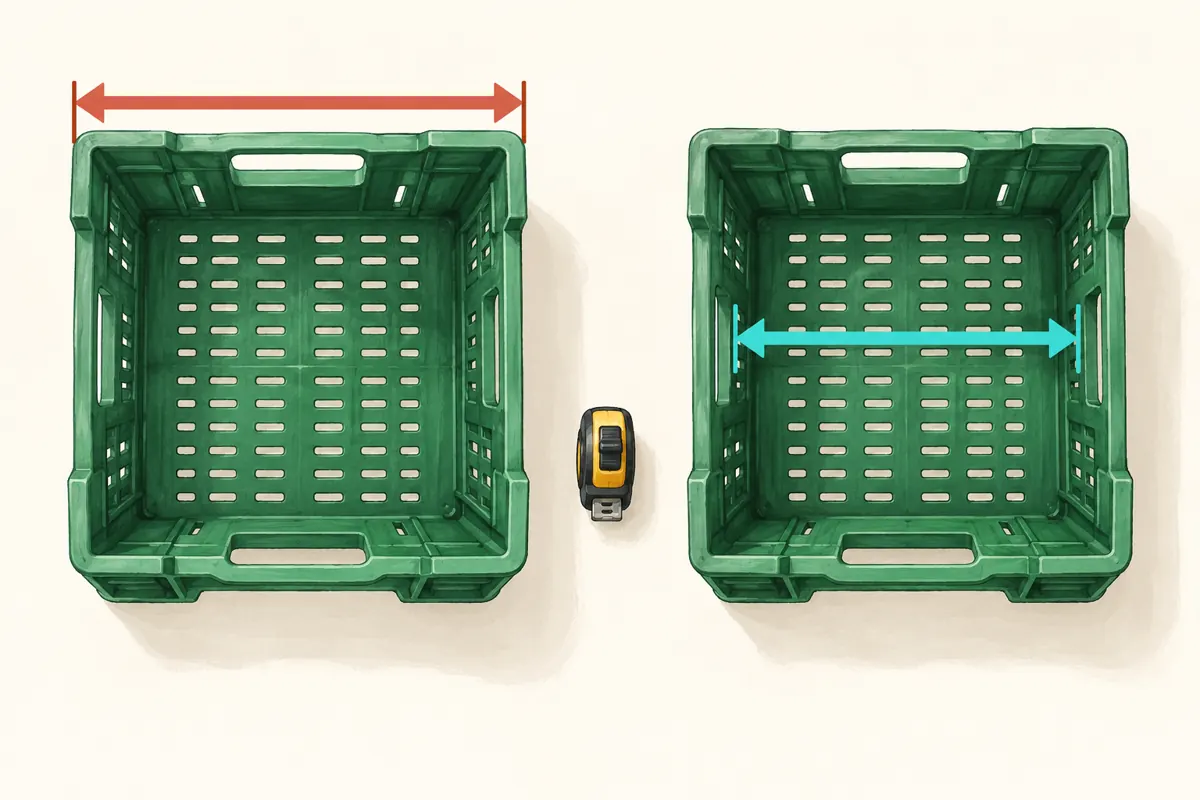
Width is not a complete specification. A buyer fitting a crate onto a shelf needs the maximum outside width, including protruding handles. Someone placing a tray inside needs usable internal space. A vendor stacking crates may need to understand how the rims connect. Before responding, establish what the customer wants to fit, carry or store. That makes the answer useful even when the original question is only “How big?”
Consider a hypothetical Phnom Penh crate shop promoting a green ventilated model. A café owner asks whether a preparation tray will fit inside and whether the crate fits beneath a counter. Those are separate checks with different measurement points. The employee should identify the tray’s outside dimensions and the counter’s available space before recommending anything. Neither a product photograph nor a familiar-looking crate proves compatibility. Keep the recommendation provisional until the relevant dimensions have been compared.
2. Prepare a post that customers can question precisely
Give each promoted crate an unmistakable reference: a model code, a clear photograph and a short description of its construction. Separate outside dimensions from internal measurements, and state the unit beside each set. Explain the order of the dimensions instead of assuming everyone reads a sequence the same way. If your team has measured only one sample, describe it as a sample measurement rather than a universal specification.
Write the promotional caption in the language your customers understand, using clear Khmer for a Khmer-speaking audience while preserving genuine model codes. Keep the enquiry instruction concrete: ask buyers to send the model reference and describe what must fit. For deliveries outside your immediate area, request the general destination first; obtain a precise address privately when needed. A readable post gives staff and customers a common reference without requiring the buyer to understand technical vocabulary.
3. Quote the relevant clause in Telegram
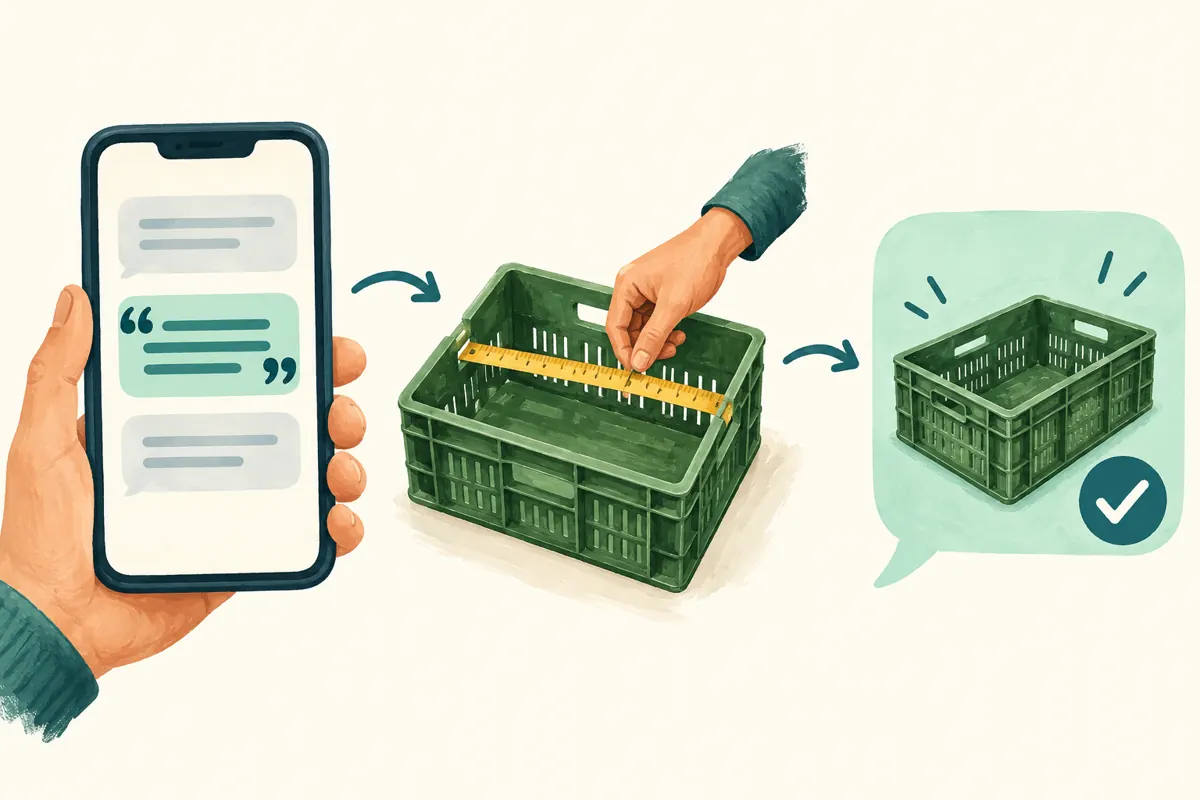
Telegram’s official Replies 2.0 guide explains that you can select part of a message for a quoted reply. On mobile, tap the message, or hold it on iOS, select the relevant text and choose Quote. Tapping a quote takes the reader to the corresponding place in the original message. Check the selected passage before sending, especially when a customer mentions several products.
Use the shortest passage that preserves the question’s meaning. In a hypothetical enquiry reading “Will the tray fit inside, and can you deliver tomorrow?”, select the complete tray-fit question for the measurement answer. Address delivery separately after checking arrangements. Avoid quoting only “fit” or “tomorrow”: those fragments remove the context you are trying to preserve. The visual attachment should help a customer follow the answer, while your actual wording supplies the model, measurement and remaining uncertainty.
4. Measure the feature the buyer actually needs
Take the stock item associated with the post and check its model before measuring. For an internal-fit question, inspect the opening, lower cavity, handle recesses and any inward taper. A tray might pass through the opening but fail to sit flat near the base. Photograph the relevant measurement with the tape positioned visibly, and explain where it was taken. Do not send a close-up that hides which crate is being measured.
For example, a hypothetical reply could say: “For model C-Green, I measured the usable space near the base because that is where your tray would rest. Please send the tray’s outside length and width, including its rim.” This gives the customer a clear next action without inventing compatibility. If the fit appears tight, suggest bringing the tray or checking a sample before committing. Do not infer load capacity, food suitability or transport safety from a dimensional check.
5. Separate facts, conditions and unanswered questions
Build each answer from three parts: what you checked, what that check means and what remains unresolved. A confirmed outside measurement can answer a shelf-space question. It cannot establish how much weight the shelf supports or whether the customer can lift a loaded crate comfortably. State the boundary plainly so that a narrow answer does not become a broad product promise.
In a hypothetical conversation, a customer asks whether matching crates stack and whether mixed models can stack together. Checking two identical samples answers only the first question for those samples. Quote and answer that part, then request the other model’s reference before discussing mixed stacking. Finish with a short recap if several questions have accumulated: fit checked, mixed-model compatibility pending, delivery awaiting destination. Use ordinary sentences rather than unexplained ticks that could be mistaken for approval of the whole order.
6. Move private details carefully
A public discussion about crate dimensions can be helpful to future customers. A delivery address, telephone number or photograph of a customer’s storage room usually does not belong in that public answer. Before responding, look at both the destination chat and the text included in the quotation. A well-intended reply can still repeat information that the buyer did not need you to amplify.
Telegram also supports replying in another chat through the reply bar. Its documentation says opening the original message from there depends on the recipient having access to the source chat. For your workflow, inspect the destination before sending and include enough neutral context for the recipient to understand the question. When discussing a private order with a colleague, share only the details needed to resolve it. If you later turn the issue into promotional content, rewrite it as a general explanation without customer identifiers.
7. Use repeated questions to improve the next promotion
After answering enquiries, record the source of confusion in a small editorial note. Useful categories include inside versus outside dimensions, unclear model identity, stacking arrangement and delivery scope. Record the question type rather than copying the customer’s entire conversation. This helps a shop improve its next post without building an unnecessary collection of personal information.
Suppose, hypothetically, several conversations reveal that buyers interpret the published width as usable internal space. Create a follow-up demonstration showing the outer rim and inner cavity separately. Explain where each measurement matters, and update the original product information where appropriate. Ask a colleague unfamiliar with the conversation to read the revised caption and identify which measurement a tray buyer needs. That simple review tests clarity. It does not prove that the revision will increase reach, enquiries or sales, but it addresses an observed obstacle to understanding.
8. Decide what an SMM service can contribute
An SMM-panel catalogue entry cannot resolve an unclear product answer. The supplied catalogue includes “Telegram 🔥 Reaction + 𝗙𝗿𝗲𝗲 𝗩𝗶𝗲𝘄”, whose title presents a reaction-and-view offer. No accompanying description was supplied, so the title alone does not establish its delivery method, audience location or quality. Confirm the current terms and applicable platform rules before considering any purchase. Do not use the listing as evidence of official Telegram affiliation.
For a crate shop, the first decision is whether the proposed service addresses the actual business problem. If buyers misunderstand internal dimensions, spend the effort on a clearer demonstration and accurate replies. Purchased engagement is not evidence of genuine interest, Cambodian users, sales or ad delivery. If panel activity exists, record it separately from customer enquiries and avoid presenting the resulting counters as customer approval. You can assess whether a measurement question was answered without buying an engagement service at all.
9. Review conversations without inventing attribution
Keep a lightweight enquiry record containing the promoted model, the question category, the evidence checked and the next action. Distinguish an unanswered question, a completed fit check, a quotation request and a confirmed order. These stages describe different events. A customer thanking you for a measurement has not necessarily decided to buy, and a request for delivery information is not a reservation.
Telegram’s Channels FAQ says channel view counters are approximate and include views of forwarded copies. Treat them as platform counters rather than a count of identifiable prospective customers. When reviewing promotion, examine whether enquiries arrived with clearer model references and whether staff still had to ask what “width” meant. If a customer volunteers where they found you, record that as their report. Otherwise, leave the source unknown. A panel order and an enquiry occurring on the same day do not establish that one caused the other.
10. Avoid replies that look precise but remain ambiguous
The most common mistake is attaching a detailed measurement to the wrong model. Another is quoting a sentence so narrowly that an important condition disappears. Preserve words such as “inside”, “with the lid” or “including the handle” when they determine the answer. Read the selected question and your response together before sending. If the pair sounds contradictory, stop and clarify the physical requirement.
Avoid replying “yes” to a message that combines fit, stock and delivery. Do not reuse yesterday’s measurement photograph without checking that it shows the current model. If you discover an error, explain the correction directly to affected customers and identify which earlier answer it replaces. Before arranging dispatch, restate the agreed product, quantity and any unresolved fit condition. This final confirmation turns a sequence of helpful messages into an understandable order discussion while keeping the customer’s decision explicit.

Frequently asked questions
Should every customer message receive a selective quoted reply?
No. Use it when a message contains several questions or when a particular phrase determines your answer. A simple, single-question exchange may need only a clear response. The purpose is to reduce uncertainty, so avoid adding unnecessary fragments and repeated replies that make the conversation harder to follow.
What if the customer sends a photograph with no measurements?
Treat the photograph as context, not a reliable scale reference. Ask for the relevant outside dimensions of the item that must fit, including rims or handles. Explain which part to measure. If the customer cannot measure confidently, offer an appropriate sample check or an in-person comparison before making a fit recommendation.
Can staff translate a customer's question inside the quote?
Keep the selected customer wording intact and place your interpretation separately in the answer. For a Khmer question containing an English model code, preserve the code exactly. If a translated term could mean either outside width or usable space, ask the customer to confirm the intended meaning before recommending a crate.
Does a quoted measurement answer confirm an order?
No. It records an answer to a particular question. Confirm the chosen model, quantity, availability and fulfilment arrangements separately through the shop’s normal process. If compatibility still depends on information the buyer has not provided, state that condition again before treating the conversation as ready for an order.
How should the shop judge whether this workflow is useful?
Review whether staff and buyers can identify what was checked and what remains pending. Look for recurring clarification questions, wrong-model answers and unresolved measurement requests. Keep those observations separate from reaction totals. The workflow is useful when conversations become easier to act on; it does not require a claim that quotation features generated additional sales.
Explore the current service catalogue, create an account, or ask a specific question through support tickets.
- Telegram: Replies 2.0, Adjustable Link Previews, Name Colors and More
- Telegram Channels FAQ: View Counters and Forwarded Copies
Prepared with AI assistance. Illustrations explain the workflow and do not represent customer results.