22/10/2026 00:35
Five Centimetres or Five Pieces? Telegram Voice Checks for Cambodian Foam Shops

A spoken instruction can sound clear until someone turns it into a product caption. Does “five” describe foam thickness, the number of pieces or the collection date? For a Cambodian shop selling custom upholstery foam, that distinction affects what customers think they can order. Telegram voice transcription can help staff review a message, but readable text still needs checking. This workflow connects the original recording, a confirmed product specification and a public promotional post. It also explains where an SMM panel record belongs, so purchased activity never becomes a substitute for accurate information or evidence of customer demand.
1. Start with the statement you intend to promote
Before transcribing a conversation, identify the public claim you need to verify. Perhaps the proposed post says the shop can cut replacement bench cushions to size. That requires confirmation of the material, available thicknesses and ordering process. It does not require publishing every detail of a customer's private enquiry. Write the intended claim in a draft and mark any detail that still depends on the recording.
Consider a hypothetical Phnom Penh foam shop preparing a demonstration post. A worker sends a voice message about a sample while the shop assistant selects photographs. The recording mentions a measurement, a quantity and a possible collection time. These belong in separate fields. Combining them into one polished sentence too early can turn a tentative workshop discussion into an apparently firm offer. First establish what each spoken detail refers to; promotional wording comes later.
2. Check transcription access before building the routine around it
Telegram's official voice-to-text announcement describes using the →A control to convert a voice message into text. Its technical documentation also describes limits for users without Premium, including a weekly allowance and a maximum message duration. Check the controls and allowance shown in your own app rather than assuming every staff account can transcribe every recording.
Try the feature with a short, non-sensitive message representative of your shop's conversations. Compare the output with the audio, especially when speech mixes Khmer, English product terms and numbers. This is a practical accuracy check, not proof that all similar messages will work. The sources cited here do not establish dependable Khmer transcription accuracy. If the control is unavailable or the result is unusable, listen and write a manual summary. The confirmation process remains the same.
3. Treat the transcript as a draft with unresolved fields
Read the transcription once for its general meaning, then replay the recording while checking decision-critical words. For foam products, those include length, width, thickness, quantity, firmness descriptions, included materials and timing. Listen especially for qualifications such as “if available,” “after checking” and “without the cover.” Removing a short qualification can change the entire promise.
Use a compact working note with three statuses: heard clearly, needs clarification and confirmed by the responsible person. These are your team's labels, not Telegram features. Keep uncertain wording visibly uncertain instead of replacing it with the most plausible interpretation. If the speaker says “the same as before,” identify the earlier sample or specification. A transcript can reproduce that phrase accurately while still leaving the assistant without enough information to write a useful caption.
4. Separate measurements, units and quantities
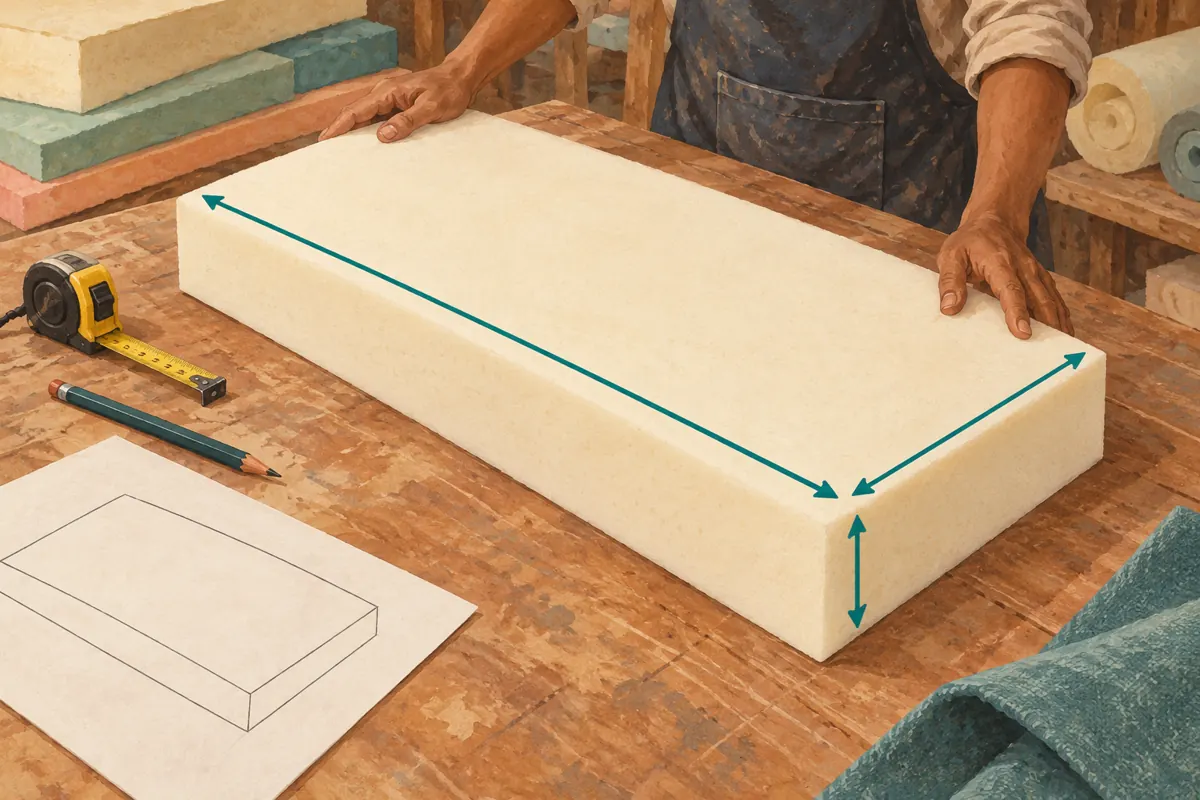
In a hypothetical example, a sample is 120 centimetres long, 45 centimetres wide and 5 centimetres thick, with two pieces requested. Record each value beside its label. These illustrative dimensions are not a recommended fit for any particular bench. A bare sequence such as “120, 45, 5, two” leaves room for mistakes when another person prepares the image or answers an enquiry.
Match the written fields to a simple drawing showing which edges were measured. Also establish whether the speaker means the bare foam, an existing cushion or the furniture opening. If someone uses a different unit, retain the original measurement and explicitly verify any conversion before publication. Do not silently correct an unusual value because it looks unlikely. Ask about that value directly. For irregular shapes, request a suitable outline or template rather than suggesting that three dimensions fully describe the job.

5. Ask for confirmation that resolves the uncertainty
Send a short read-back to the person who can verify the detail. In the hypothetical example, the assistant might write: “Please confirm: two bare foam pieces, each 120 cm long, 45 cm wide and 5 cm thick. Covers are excluded. Collection timing is still unconfirmed.” This separates the specification from an outstanding operational decision.
Avoid asking only “Is this okay?” beneath a long conversation. The recipient may approve the photograph while overlooking the measurements. If the reply addresses only thickness, leave the other disputed fields open. A customer can confirm their requested dimensions; the shop still needs to confirm material availability and its ability to complete the work. Record who confirmed which detail and when. If a colleague takes over, they should be able to see the unresolved question without replaying the entire chat.
6. Turn the confirmed specification into useful public content
Build the promotional post around a buyer's next decision. A foam-cutting demonstration could show the sample, explain the difference between length and thickness, and tell viewers what information to send for an enquiry. Use the language your intended customers understand. For a Khmer-facing post, have a fluent reviewer check the measurement labels and exclusions rather than relying on a translated transcript alone.
A hypothetical caption could explain that the photograph shows a bare foam sample, that covers are separate, and that customers should send dimensions and quantity for assessment. Only include options the shop actually offers. A customer's one-off specification does not establish a standard stocked size. Likewise, a worker's tentative completion estimate should not become a general same-day promise. Keep the public explanation focused enough that someone viewing it without the original conversation can understand the product and the next step.
7. Keep private recordings out of the promotional asset
An internal voice message may contain a customer's name, address, negotiated price or description of their home. Those details are unnecessary for demonstrating foam thickness. Create a fresh public explanation from the approved facts instead of posting a screenshot of the transcript. A clean sample photograph and your own narration usually communicate the relevant information more clearly.
If the content needs a customer's recording or identifiable project, obtain permission for that specific public use. Permission to discuss an order does not automatically establish permission to turn the conversation into advertising. Keep the source recording and confirmation note accessible only to staff who need them. The person arranging promotion generally needs the approved public asset and its destination, not the customer's entire chat. Check photographs too: delivery labels and handwritten job sheets can reveal information even when the caption is clean.
8. Decide whether a panel service addresses the actual need
The supplied smm-cam.com catalogue includes “Telegram Post Views ~ Max 100k ~ 20k/Days ~ 0-1 Hours”. Its title identifies a post-view offering, but the supplied description is empty. The title alone does not verify its delivery method, audience origin, timing or other operational conditions. Nothing in that information establishes transcription, content review or measurement verification as part of the service.
If the problem is an ambiguous product offer, resolve the offer first. If the objective is enquiries from Cambodian buyers, purchased views do not demonstrate that outcome. Purchased engagement is not evidence of genuine interest, sales, ad delivery or Cambodian users. Review the actual service terms and relevant platform rules before considering any purchase, and decline when the method or purpose is unsuitable. Do not use a higher counter to imply that customers have endorsed the shop's cutting quality or approved the sample.
9. Connect the approved post to a clear promotion record
Once the shop has approved the public content, record its exact destination and a short description of the asset. For example, an internal note might identify the bare-foam measurement demonstration and distinguish it from a separate finished-cushion photograph. This prevents a promotion request from being attached to a similar-looking post with different specifications.
If a panel order is placed, keep its service name, order reference and reported delivery status in a separate part of the record. Do not paste private audio or customer details into service inputs or support messages. If a measurement error is discovered after promotion begins, correct the public information promptly and document the change. Check the provider's stated options for the existing order rather than assuming an edit cancels delivery. Avoid submitting another order merely because the first post now has corrected wording.
10. Review customer understanding separately from counters
Telegram's Channels FAQ explains that channel view totals are approximate and include views of forwarded copies. That makes the counter a limited observation, even before any purchased activity is considered. It cannot tell you whether viewers understood the difference between foam thickness and piece quantity, or whether they are within the shop's service area.
Instead, review the questions people actually send. Are they providing all three dimensions? Do they still think covers are included? Are they asking for a quotation or merely identifying the material? Keep these observations separate from accepted orders and completed sales. Where staff have to explain the same missing condition repeatedly, improve the next demonstration. Avoid crediting a panel order for an enquiry unless you have evidence supporting that connection. A useful editorial outcome is a clearer buying conversation; it should be assessed from those conversations.

Frequently asked questions
Can a clear-looking transcription be used directly as a caption?
It should still be reviewed. Smooth wording does not establish that numbers, units or qualifications were captured correctly. Compare critical details with the recording, obtain the relevant confirmation and rewrite the information for someone who has never seen the private conversation. Remove personal details and unresolved promises before publication.
What should staff do if Khmer transcription is inaccurate?
Ask a fluent listener to prepare a manual summary and read back the critical fields to the speaker. Request a typed measurement or marked drawing when a number remains unclear. Do not repeatedly reinterpret uncertain text until it looks plausible. The aim is a confirmed specification, regardless of whether automation helped produce it.
Does a customer's confirmation mean the shop can advertise that size?
It confirms the customer's request only to the extent stated in their reply. The shop must separately establish that it can supply the material and perform the work. A custom request should not be described as a stocked product unless that is true. Permission is also needed before using identifiable customer material publicly.
What if the transcript and the product photograph disagree?
Pause the disputed claim and identify which item each source describes. The photograph may show an earlier sample, or the speaker may be discussing another thickness. Ask the responsible worker to match the approved specification to the correct image. Do not choose whichever version produces the more attractive offer.
Can Telegram post views show whether the explanation worked?
Views alone cannot establish comprehension or buying intent. Review relevant enquiries for signs that readers understand the measurements and exclusions, while keeping accepted orders in their own record. If purchased activity was involved, document it separately and never present the resulting counter as proof of organic popularity, local demand or sales.
Explore the current service catalogue, create an account, or ask a specific question through support tickets.
- Telegram: Similar Channels, Reposting Stories, and 9 More Features — Voice-to-Text for Everyone
- Telegram Technical Documentation: Voice Message Transcription
- Telegram Channels FAQ: What Does the Eye Icon Mean?
Prepared with AI assistance. Illustrations explain the workflow and do not represent customer results.