21/10/2026 17:08
Frame Opening or Outer Edge? Telegram Quizzes for Cambodian Picture-Frame Shops

A customer sends a frame photograph and asks for the same size. Your assistant sees the outside wooden edge; the customer means the picture visible inside it. Both think the request is clear. For a Cambodian framing business promoting its work through Telegram, a short educational quiz can expose this misunderstanding before it enters a quotation. The useful outcome is a clearer conversation about measurements. This guide shows how to choose one question, prepare an understandable illustration, test the quiz, explain the answer and connect interested readers with your enquiry process. It also explains where SMM panel records belong when reviewing that activity.
1. Choose one misunderstanding worth teaching
Start with a question your staff actually encounter. Review recent enquiries without copying customers’ names, private photographs or contact details into public content. Look for a recurring distinction: the complete sheet of artwork, the visible opening at the front of a frame, or the finished frame’s outside dimensions. These describe different things, even when customers casually call all of them the frame size.
In a hypothetical Phnom Penh workshop, customers often send the width of an existing frame when requesting a quote for an unframed print. The shop chooses a modest learning objective: readers should recognise which object the assistant is asking them to measure. This is specific enough for one quiz. Questions about moulding material, glazing, mounting and delivery can wait for separate posts.
2. Decide whether a quiz suits the question
A quiz works when the question has a defensible answer under clearly stated conditions. Telegram’s official Polls 2.0 guide describes Quiz Mode and creating polls through the attachment menu in groups or channels. For this workflow, design a question with one intended correct answer. The official guide is listed in the sources.
Do not mark a customer’s taste as wrong. Choosing between a dark frame and a light frame is a preference question unless you have specified an objective constraint. Similarly, asking which frame is best for every photograph is too broad. If staff disagree about the answer, narrow the scenario or publish an explanation instead. The content should make a practical distinction easier to understand, rather than turn a complicated purchase into a guessing game.
3. Establish what each measurement describes
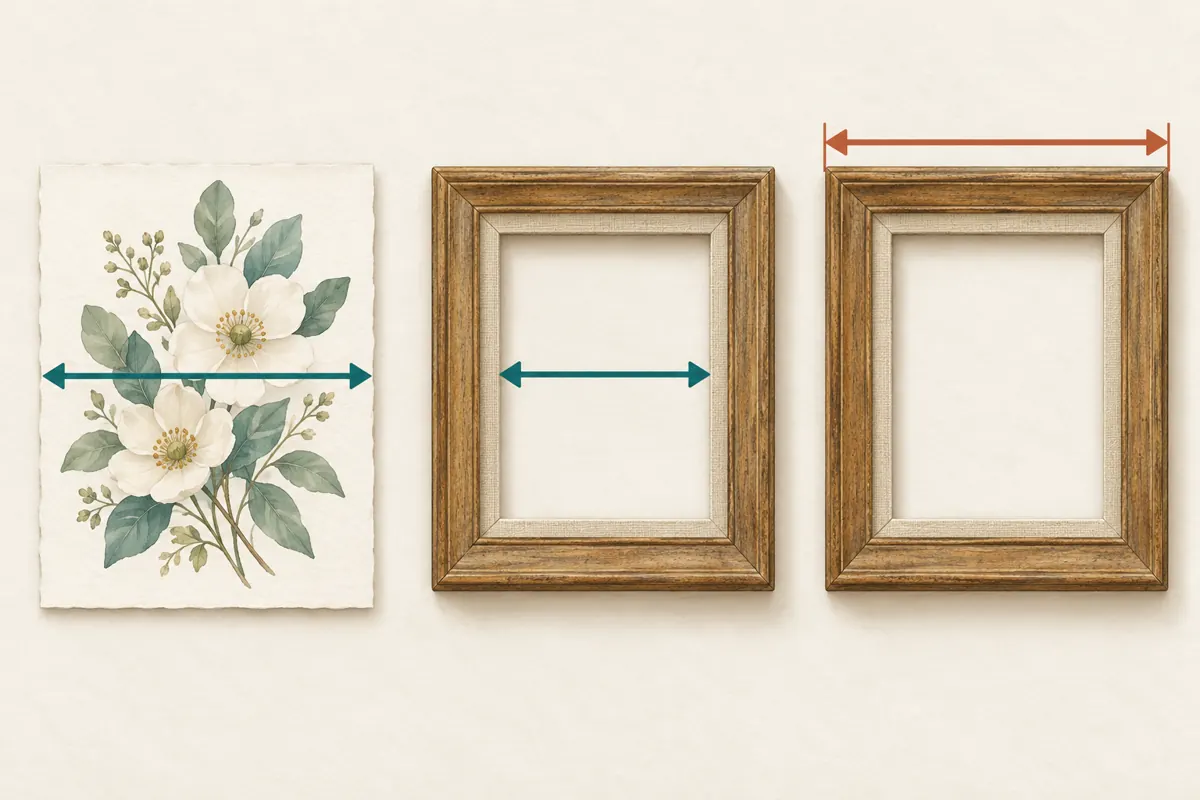
Prepare a simple visual showing the artwork separately from the frame. Then show the visible front opening and the full outside width as distinct measurements. Use arrows whose endpoints touch the relevant edges. Avoid perspective that makes an arrow seem to point behind the frame. The article’s measurement illustration is conceptual; it is not a cutting guide or a promise that the pictured objects fit together.
Explain that the visible opening is not automatically the dimension used to fit artwork into a frame. A mount, overlapping edge or different frame construction can change what is visible. Your staff should confirm the actual product requirements before giving a final quotation. Ask customers to name the object they measured and state the unit, rather than sending an unexplained pair of numbers.
4. Write a question that contains its own context
Here is a hypothetical quiz draft: “You have a loose print with no frame. Our assistant asks for the full paper size to begin a quotation. What should you measure?” The options are “The complete paper, edge to edge”, “Only the printed image inside its white border” and “The outside of another frame”. The intended answer is the complete paper because the question explicitly asks for full paper size.
This wording avoids suggesting that every framing job starts with the same measurement. It also remains understandable if someone encounters the quiz without studying the earlier illustration. Keep answer options similar in length and grammatical form. Avoid clues such as making the correct option unusually detailed. Do not use double negatives or joke answers that distract from the distinction customers need to learn.
5. Prepare the explanation before publishing
Write the explanation while drafting the question. For the hypothetical example: “Full paper size includes the white border. Send its width and height with the unit. We will discuss how much border you want visible and confirm the frame specification separately.” That answer gives readers something useful to do after selecting an option.
Place the explanation in a clearly identified follow-up message so people can read it whether or not they participate. Telegram’s technical documentation also describes quiz solutions, but your educational sequence need not depend on a particular client showing an explanation field. Avoid promising a price from this measurement alone. A customer may still need to identify the artwork material, preferred presentation and whether an existing frame must be matched.
6. Build and test the quiz with a colleague
Open the intended group or channel using the account authorised to post there. Find Poll in the attachment menu, enter the question and options, select the quiz settings available in your client, and mark the intended answer. Check the displayed settings before sending. Menu placement can vary between devices, so rely on the labels in the app rather than an old screenshot.
Run a trial in a staff-only group first. Ask a colleague who did not write the question to explain why they chose their answer. A correct selection with confused reasoning still reveals a drafting problem. Check the visual on a small phone, especially the arrow endpoints and any white border around the artwork. If you prepare a Khmer version for customers, have a fluent reviewer check the measurement terms and preserve the same meaning across versions.
7. Publish a short learning sequence
Use a compact sequence: an illustrative post, the quiz, then the explanation and an optional enquiry invitation. Introduce it as a quick measurement check, not an examination of customer knowledge. Keep the illustration and quiz close together in the conversation so unrelated promotional posts do not interrupt the task. Assign someone to answer follow-up questions while the content is being actively shared.
A suitable enquiry invitation might say: “For a framing quote, send a photo of the loose artwork, its full paper width and height, and the unit used.” Ask for further details privately as needed. Readers should not need to expose a family photograph, certificate or address in a public group to get help. Participation should remain optional, and a correct answer should never be presented as a reservation or accepted order.

8. Treat confusing answers as editorial evidence
Review the responses alongside actual questions. If readers choose the printed image instead of the full paper, check whether the border was visible and whether the wording explained that it counted. If they choose another frame’s outside dimensions, add a follow-up showing why changing the wooden moulding can change the finished outside size. Improve the explanation before assuming readers were careless.
A quiz result only describes participation in that particular activity. People may guess, already know the subject or misunderstand the language. Those who answer are not necessarily representative of everyone who saw the post. Record what the content taught you: which distinction needed another example and what staff changed. Avoid turning a correct-answer share into a claim that customers are ready to buy.
9. Keep SMM services outside the learning evidence
The supplied catalogue includes the exact public listing “Telegram - Channel/Group Members ~ Max 1.5M ~ 3 days No Drop ~ 100k/days ~ INSTANT”. Its title identifies a member-related offer, but the brief supplies no supporting description. Treat the remaining wording as listing claims requiring clarification, rather than verified delivery conditions or evidence of audience quality.
Nothing supplied establishes that this service provides quiz participants, qualified framing enquiries or Cambodian customers. It cannot validate whether your measurement explanation works. Purchased engagement is not evidence of genuine interest, sales, advertising delivery or Cambodian users. Do not purchase or solicit selected answers to manufacture a favourable learning result.
If your business separately reviews an SMM purchase, keep its service name, stated scope and order record in the administrative file. Keep the quiz question and editorial observations in the content file, and customer requests in the enquiry record. For this educational task, the sensible first decision is to publish a clear explanation and evaluate voluntary questions without buying activity.
10. Correct mistakes and choose the next useful post
Common mistakes include asking about an unspecified frame size, showing arrows that stop short of the edges, omitting units and treating a vote as an enquiry. Another is publishing an answer that sounds universal when it only applies to the pictured example. Review both the image and wording whenever a customer identifies an exception. An accurate correction is more useful than defending an ambiguous question.
If the answer key or scenario is wrong, publish a visible correction explaining the issue. Stop using that quiz as evidence of comprehension and prepare a corrected version when necessary. Preserve enough internal context to distinguish the versions. Choose the next post from unresolved practical questions, such as photographing a paper border clearly or describing an existing mount. This creates a useful promotion routine grounded in the work your shop actually does.

Frequently asked questions
Should we ask for the visible opening or the full artwork size?
Ask for the measurement needed for the particular task and name it explicitly. For an initial enquiry about a loose print, the full paper size can establish a starting point. Matching an existing display may require other measurements and photographs. Your staff should confirm fitting requirements; the quiz does not establish a universal sizing rule.
Can this quiz be useful if only a few people answer?
Yes, if it helps identify unclear wording or prompts a useful customer question. A small response gives limited evidence, so avoid broad conclusions about your audience. You can also ask staff whether later enquiries identify the measured object more clearly, while acknowledging that other content and conversations may have influenced those enquiries.
Do we need a bot or paid SMM service to run this workflow?
The basic workflow uses Telegram’s built-in poll creation and ordinary explanatory posts. It does not require a bot or a purchased audience. The supplied member-service listing does not establish any quiz functionality. Start with one manually reviewed question so your team can check the content and respond to misunderstandings.
What if a customer gives a reasonable answer that the quiz marks wrong?
Read their reasoning before judging the response. They may have assumed a mount, an existing frame or a different meaning of paper size. If your wording allowed that interpretation, acknowledge it and clarify the scenario. Treat the incident as a content defect to fix, rather than evidence that the customer lacks knowledge.
How can we tell whether the post generated a real enquiry?
Record an enquiry when someone actually requests help or a quotation. If relevant, ask which post brought them to the conversation and preserve their answer without assuming attribution. A quiz selection, channel membership or view is a different event. Confirmed work requires your normal quotation and approval process, regardless of quiz participation.
Explore the current service catalogue, create an account, or ask a specific question through support tickets.
- Telegram: Polls 2.0 — Visible Votes, Multiple Answers, and Quiz Mode
- Telegram API: Polls and quizzes
Prepared with AI assistance. Illustrations explain the workflow and do not represent customer results.